
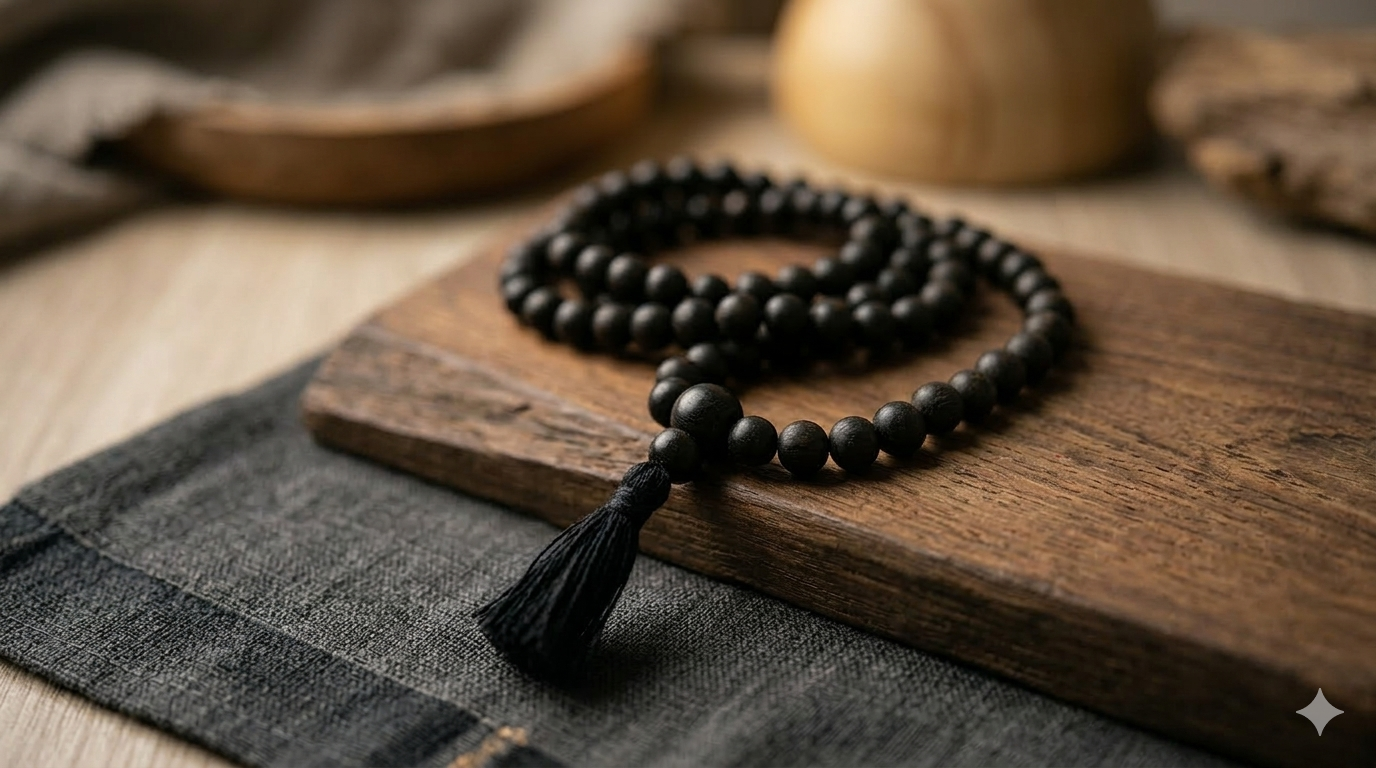
There is something attractive about the deep, midnight-black beads of a Karungali Mala. When you hold one in your hands, the first thing you notice is its surprising weight and the coolness of the surface. It does not feel like ordinary wood. It feels solid, grounded, and ancient.
If you have seen these black beads worn by spiritual seekers or heard people talking about their calming influence, you might be wondering what karungali mala is. It’s a specific type of stone, or is it truly a gift from the forest? The answer lies in the heart of a very special tree that has been revered in South India for millennia.
What Does “Karungali” Actually Mean?
The name “Karungali” tells a story all on its own. In the Tamil language, the word is derived by combining two ideal words. Karum refers to the colour black or a dark colour. Gali refers to the sturdy heart of a thing. Together, Karungali represents the powerful, dark centre of a tree that has survived the elements for decades.
In many traditions, the colour black is not seen as something negative; it is seen as a safeguarding shield, as the colour black absorbs all light.
The Karungali Mala is believed to absorb excess heat from the body and negative energy from the mind. It represents a state of being centred and unshakable, much like the wood itself.
“True strength is often silent and hidden deep within. The Karungali wood acts as a physical symbol that our own inner core is the source of our stability.”
The Science of Ebony: What Makes This Tree Special?
To understand the mala, you have to look at the tree it comes from. Known botanically as Diospyros ebenum, this is the Indian Ebony tree.
Unlike fast-growing softwoods, the Karungali tree grows incredibly slowly. Over decades, it draws minerals from the soil to create a wood so dense it defies the usual rules of timber. This isn’t just a piece of a branch; it is the concentrated life force of a tree that has hardened into something nearly as tough as stone.
Names change as you cross regional lines, but the admiration for the tree is the same. If you are looking for the karungali mala tree name in Telugu, you will find it called Nalla Chandra. People have recognised this across cultures for generations as a spiritual symbol.
From Temple Towers to Your Wrist: A Brief History
The history of karungali wood is deeply tied to the sacred architecture of South India. For centuries, temple builders chose this wood for the most important parts of the structure.
The reason was practical as well as spiritual, as the wood is so dense that it is incredibly resistant to decay and insects.
Historically, ancient scholars and astrologers recommended this wood for:
- Balancing Mars (Angaraka): It is often worn by those looking to mitigate the effects of Mars in their birth chart.
- Managing “Heat”: Whether that’s physical body heat or a “heated” temperament.
- Spiritual Grounding: Providing a physical weight to help center the mind during meditation.
Physical Traits of the Original Karungali
How does wood feel so much like a stone? The real karungali tree produces uniquely heavy wood. If you take a bead of authentic heartwood and drop it into a glass of water, it will not float. It sinks straight to the bottom. This density is one of the easiest ways to verify the real material.
The texture is another giveaway. Unlike many woods that require heavy varnishes, the karungali mala tree produces wood that has a natural, oily lustre. When polished, it shines with a soft, matte glow.
“Authenticity in Karungali is felt through weight and temperature. If the wood feels light or warm like plastic, it hasn’t spent the necessary decades maturing in the core of the forest.”
FAQs
Is Karungali the same as Ebony wood?
Yes, the Karungali tree is the Indian Ebony tree. While there are different types of Ebony across the world, the variety found in South India is what is traditionally used for these sacred malas.
Can anyone wear a Karungali Mala?
Unlike some ritual items that require specific lifestyle changes, as long as you treat it with basic respect, it can be worn by anyone seeking a sense of grounding and focus.
Why is my Karungali mala turning grey or dull?
Over time, the natural oils from your skin may interact with the wood, or the wood may dry out slightly, giving it a greyish tint. This is normal. You can often restore its dark lustre by lightly rubbing it with a drop of natural oil, like coconut or sesame oil.
How can I tell if my Karungali wood is real?
The “Water Test” is the most common method; authentic heartwood from an original karungali tree will sink in water because of its high density. Additionally, real Karungali feels naturally cool to the touch and has a dense weight compared to common wood.
What is the meaning of 108 beads in a Karungali Mala?
The number 108 is considered sacred in many traditions, representing the universe’s wholeness. Using Karungali wood in this format combines the natural properties of the tree with the spiritual discipline of meditation.
Conclusion
The Karungali Mala is a beautiful example of how nature provides us with tools for our well-being. From its origins as a slow-growing tree in the forest to its way in the peaceful halls of ancient temples, this wood has always been a symbol of strength and stability.
You might be drawn to it for its history, or you are curious about how other sacred woods can be part of your life. We invite you to explore our deeper dives and stories over on the blog.
